How Do You Wait?

Be patient, then, brothers and sisters, until the Lord’s coming. See how the farmer waits for the land to yield its valuable crop, patiently waiting for the autumn and spring rains. You too, be patient and stand firm, because the Lord’s coming is near.

James 5:7-8

Do you wait well, or do you wait poorly? It’s a question that applies to both little things like waiting for a bus, or for your spouse to be ready, as well as to big things like waiting for a promotion, waiting to get married, or waiting for Jesus to return. How well do you wait?  And what does it produce in you when you’re forced to wait much longer than you feel is necessary?

Advent, by definition, is all about waiting—waiting for promises, yet unfulfilled, to be realized.  It’s a time when we are invited to re-establish hope, especially concerning things that we are still waiting for. And, as we all know, that’s not an easy thing to do.  To wait is a test of our faith.  The question is not whether we have to wait or not.  It’s more a question of how we wait for the things we long for.  Do we wait anxiously, or in the security of faith?

Scripture is full of stories of people dealing poorly with their unfulfilled needs.  The prodigal son is perhaps the best known example of someone who is impatient with the slow progress of their lives.  We know what we need.  God is taking too long.  We find ourselves becoming restless, or tempted with despair.  And after a short period of waiting we give up on the hope of God’s initiative and resort instead to our own agenda.  But there’s a whole world of faith that lies just on the other side of giving up.  The person who sets out to “wait on the Lord” must first learn to resist the type of despair that causes us to prematurely give up on hope.

Waiting is related to hope in that it presumes that God is faithful, and that it is worth waiting for what He brings.  Growth in this type of discipline leads to an open-handedness where we no longer cling to our own expectations of what, how or when we will receive whatever God has in store for us.  To practice waiting is to practice spiritual detachment.  Like all forms of detachment, waiting means deferring to God—humbly letting go of control, in this case control of time and outcome.

On the second Sunday of Advent we light the candle of peace.  It is the disposition we are to seek in the midst of all that we know is still lacking in life.  We wait in a posture of faith while honestly accepting the predicament of where we are in our journey.  We are still far from home. Like the Israelites in Babylon, we too are in a place of exile from which we yearn for the courts of the Lord.

Advent is also a time to establish hope with all that still seems to be lacking in our relationship with God.  Jesus has come to us, but not yet fully. We know there is more. We have been promised greater things than we have yet received and, in faith, we await that which is still to come.  In this we identify with the waiting ages before Christ was born.  We enter the condition of those who have not yet received what they long for.  We make their hopes and their aspirations our own as we sing their words, “O Come, O Come, Emmanuel and ransom captive Israel.”  As to the degree that we do so in a posture of faith, we honour God with our confidence that His promises are not only sure, but they are also well worth waiting for.

In the morning, LORD, you hear my voice; in the morning I lay my requests before you and wait expectantly.

Psalm 5:3

Moving Beyond Fear

Mary was greatly troubled at his words         Luke 1:29

In the story of the Annunciation, Mary’s faithful reply “Let it be unto me, according to your word,” has long been heralded as the epitome of trusting God.  Without any real understanding of what the Lord is asking of her, Mary nevertheless gives unequivocal consent to God’s action in her life.  But it is good to keep in mind that this wasn’t her first response.  Before she was able to find such faith within herself, Mary, like all of us, first had to work through her initial fears.

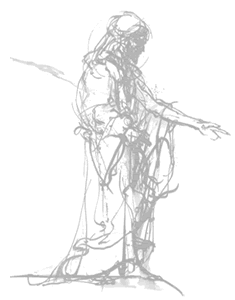
Mary was not only troubled by what she didn’t understand, but “greatly troubled” as Luke expresses it.  Her body language, so lyrically expressed in Alessandro Botticelli’s 15th cent. painting, reflects something of the apprehension Mary likely felt.  There was too much coming at her and she wanted nothing more than to stand back from it all, to hold it at bay.

We too can recognize similar times in our lives—times when we can’t control what is about to happen.  We just want everything to stop.  Like a child who is attempting to go down a very high slide for the first time, we brace ourselves against the sides, unsure if we really want to let ourselves go.  Like any of us in such fearful situations, Mary’s first instinct was to put the brakes on life.

Seeing her obvious apprehension, the angel assures Mary, “Do not be afraid,” and then announces that she will soon give birth to a child who will be called the Son of the Most High.  This might not have been the most consoling information to add, but it did allow Mary time to compose herself.

Mary’s next response is familiar to us in how we too deal with our fears—she wants to reason with God.  She asks, “How will this be, since I am a virgin.”  It’s a fair question and one that we could see ourselves asking as well.  “Help me understand so that I can believe.” But unfortunately, faith works the other way around—it is only through believing that we come to understand.  We can learn all we want about the faithfulness of God but it is only by putting that theory to the test that we will ever experience just how faithful God really is.

The angel goes on to shed some more light for Mary.  He speaks to her not only of her own destiny but also that of her cousin Elizabeth who, though barren, has conceived a child.  At this point, Mary is more reconciled to the idea of trusting God.  She has moved from a troubled spirit, to reasoning with God, and finally to a more faith-filled acceptance of God’s word.  “I am the Lord’s servant,” she answers, “Let it be unto me, according to your word.”  In other words, “I accept that You know better than I do what You are asking of me.  And I am prepared to trust Your judgment more than my own fears.”  Isn’t this all God is asking from any of us?

The rest, as they say, is history.  God honours Mary as blessed among women simply because Mary has honoured God with her unequivocal trust.  This, it would seem, is what the Lord looks for in us as well.  And if we don’t get stuck at either the fear or the reasoning stage of things, this is the type of faith that we too can hope to end up with.

Mary’s words “Let it be unto me, according to your word” do express something of a perfect posture of faith.  But let us also remember that even Mary, the mother of Jesus, had to first work through her initial fears before she could get to that place of unequivocally trusting God’s ways with her.

Why Do We Pray?

It (relationship with God) does not depend on human desire or effort, but on God’s mercy.  Rom. 9:16

What first comes to mind when you hear the phrase, “spiritual discipline?”  For some, these are words that immediately deflate the heart.  We croak at the thought of seeing yet another well-intended spiritual resolution peter out from lack of willful support.  For others these words represent a call to arms, a challenge that they welcome as they would a dare.  It immediately brings out their competitive nature.  These are people who live for the Mt. Everests of life and who get great satisfaction out of conquering the ground around them, any ground.

Discipline is good.  No one would deny that.  But when it comes to how it relates to our pursuit of God perhaps it is more important to ask ourselves why we are doing the things we do.  Why do we pray each day?  Why do we fast?  Why study the Scriptures?  Is it because it truly serves God?  Or does it only serve the hopes and ambitions we have for ourselves?  Is it because we are responding to God’s invitation to meet with Him?  Or is it only because we’ve told ourselves to do this?

In our society, we are used to thinking causatively about most of the things we do.  No pain no gain.  Practice makes perfect.  If you do this, or buy that, then you will gain this or that for your life.  In this mindset everything becomes a means to an end.  We assume that we can master all forces of nature to our benefit.  It’s no wonder then that we also tend to approach our spiritual practices in the same way.  Prayer, Bible study, fasting, even tithing are often seen or presented to us in primarily utilitarian terms.  They are things we do in order to achieve something else.

We can easily mistake zeal for God for what the Lord might more accurately see as our hidden strategy for self-improvement.  God becomes a means to an end and, if we are honest with ourselves, that end is usually us.  Convinced that human effort will get us there, we look to God in order to better our lot in life.  But it does not take long before we find our spirituality thinning and our prayer life a place of discouragement.  The Lord, in His wisdom, has ordained that the door to intimacy is closed to anyone who would try to enter by any means other than love.

Scripture tells us plainly that the reason we love God is because He first loved us (1Jn 4:19).  It is important that we be wise to the many ways we turn that order upside down.  The presumption that we can become more spiritual through any effort of our own is something we should always be wary of.  And one of the best ways to counter this is by simply asking ourselves, as often as we suspect other motives, why we are doing the things we do.  Are we picturing spiritual discipline as a way to build up our spiritual muscles, or to perhaps lose weight in an attempt to reach our ideal spiritual body shape?  Do we see our spiritual life as the initiative we take in order to reach God?  Or is it truly a response of the heart to the initiative God has already taken to reach us?

It requires ongoing and subtle discernment to ensure that we remain in a position of response with God rather than one of initiative.  But it is a distinction that will make a world of difference in how we experience the spiritual life—either as a carrot at the end of a stick, always out of reach, or as a carrot already in hand.  If it is the latter, we have much to look forward to in the many ways we get to eat it.

Keeping the Bar High

If you have raced with men on foot and they have worn you out, how can you compete with horses? Jer. 12:5

For over twenty years I worked as a professional musician, much of it as a jazz flutist in Toronto and Vancouver.  I’ve done a number of recordings, have performed internationally and have taught and lectured on jazz in various contexts.  But as my life became more and more defined by pastoral ministry, I eventually stopped playing professionally so that I could focus more on the work God was calling me to in spiritual direction.  I still practice and perform on occasion, but for more than a decade now, most of the music I am involved with is on an amateur level.  I say this without regret.

For many years though, I have been aware that I had lost vision for myself as a musician.  Though I still practiced as often as I could find time for, it was mostly just to keep my technique up to a reasonable level.  For a long time, I know that my practice has been geared more to maintenance than to improvement.  Its purpose has been to simply keep me from losing whatever skills I have acquired over the years.

This past summer however, as part of my holidays, I went to a week-long jazz workshop with some of Canada’s best jazz musicians.  Those who know jazz will recognize names like Don Thompson, Phil Dwyer, Neil Swainson, Oliver Gannon and Ian McDougall.  It was a curriculum designed for professional and semi-professional musicians.  It’s been years since I’ve had opportunity to play at this level and the effect that this camp has had on my vision has taught me much about the similar dynamics of apprenticeship that happen in my spiritual life.

The opportunity to be around others who live their lives immersed in music resurrected in me many of the old passions I still feel for this art.  Playing alongside such stellar musicians naturally raised my game up a few notches.  The effortlessness with which they negotiate the various charts gave a vicarious grace to my playing as well.  I see this as very similar to what happens when I am in the company of others who share my spiritual passions.  I love being with people who know more than I do about the spiritual life, and who have more grace in living it than I do.  Something of their commitment and love for prayer kindles the passion of my own love for God.

The other value I recovered from this jazz camp was that of a renewed vision for what artistic growth might look like for me.  I came back with a much more specific sense of where I want to be as a musician, and with new energy to commit to the practices that will get me there.  Again, this is also what happens in me when I am with people who are truly committed to their own spiritual direction.  Something good rubs off that helps me set my sights far higher than I ever could on my own.

Through the prophet Jeremiah, the Lord encourages us to raise the bar of our own race so that we can compete even with horses  Who are the horses in your life, those who are perhaps running at a pace that makes you work harder just to keep up with?  Who are those who have not lowered the bar of Christianity in their lives, and around whom you would not comfortably do so yourself?

Our faith calls us to stand apart from the pack of “men on foot” and to aspire, because of God’s enabling grace, to run in high places with the grace of a deer (Ps. 18:33). What will inspire you towards such high places in your vision for the spiritual life?  A retreat?  Spiritual direction?  Meeting regularly with other motivated Christians?  We each carry a particular vision for the spiritual life that we think we could be living.  What will motivate us to be more dedicated to the spiritual person we feel God inviting us to be?  Who will inspire us to cherish that vision more than we do now?

We are most satisfied in our spiritual life the more we are actually living it. And the less discrepancy there is between the spiritual life we envision for ourselves and the one we are actually living, the more we will enjoy peaceful accord with the person God is calling us to be.

Established in Christ

Continue in your faith, established and firm, not moved from the hope held out in the gospel.  Col. 1:23

Spirituality is not something we accumulate.  Nor is it a matter for which any language of acquisition is really appropriate.  It is always a fallacy to think in terms of quantifiable spiritual growth in an economy that is based solely on God’s grace.  Since we do not own or possess whatever spiritual life we have, we should always be wary whenever we find ourselves thinking in terms of loss or gain with regards to our relationship with God.

As humans, we tend to assess all things, including ourselves, in terms of progress—that we are getting better in this area, or regressing in that area of our lives.  Because we are temporal we think sequentially.  But God is beyond space and time, and a different vocabulary is necessary when we speak of maturity in this relationship.  Rather than talk about “spiritual growth” as if we were accumulating a yield, we should perhaps consider the preferred expression that both Peter and Paul use when they describe the mature spiritual life as one that is “established” (or “made stable”) in Christ.

In his letter to the Colossians, for instance, Paul describes those who are mature in their faith as “established and firm” (Col. 1:23).   The Greek word we translate as “established” in this verse is hedraios, which carries the sense of something that is immovable and steadfast.  Far from describing something progressive, the word refers to something sedentary.  It is the image of a person sitting securely in one place—one not easily moved from their hope.

Being established in faith then has less to do with growth than with being settled in relationship to the foundation of our lives.  The word Peter uses to describe those who are “established in the truth” (2Pet. 1:12) is sterizo, which speaks of something that is firmly set in place, like concrete or a rule of law.  As applied to our faith it defines a state of soul that is confirmed and constant in its bearings.

Since the Trinity is an established and ontological fact, there is no question of our gaining any more of this relationship than that which already exists.  The New Testament hope for our lives is that we be more firmly and consistently established upon this truth.  As Col. 4:12 prescribes, faith is a matter of our “standing firm in all the will of God, mature and fully assured.”  The only progression we can then speak of is that of our growing capacity to recognize when we have moved away from this foundation, and knowing how to return without delay.

The spiritual life then is more of a deepening disposition than a quantifiable asset.  It is an attitude of greater freedom in relationship to the movement of God’s will and of giving God increasing access to our lives as a forum for His will.  Even our capacity for prayer should not be thought of in terms of an accumulating skill, but more as an opportunity to grow in familiarity, attentiveness and appreciation of the already-existing foundation of Christ upon which, at every moment, we are invited to firmly establish our faith.

So then, just as you received Christ Jesus as Lord, continue to live in him, rooted and built up in him, strengthened in the faith as you were taught, and overflowing  with thankfulness.

Col. 2:6